
Joint pain isn’t inevitable. Most runners accept knee strain, ankle stress, and chronic inflammation as normal training costs. But this acceptance is misguided. Your joints are remodeling constantly. With strategic nutrition, you can accelerate repair and reduce pain.
The solution is nutrient-dense bone broth. Collagen broth recipes for joint pain aren’t trendy wellness drinks. They’re pharmaceutical-grade joint support delivered through whole-food nutrition. Your bones, cartilage, and connective tissue are built from collagen, gelatin, and minerals broth provides in bioavailable forms.
This guide walks you through the science of collagen and joint repair, explains why broth works where supplements fail, and provides six tested collagen broth recipes designed specifically for runners managing joint strain. By the end, you’ll understand how to brew recovery nutrition that reduces inflammation, strengthens connective tissue, and allows you to train without chronic joint pain.
Understanding Joint Structure and Collagen’s Role
Before choosing broth recipes, understand what your joints need.
Joint Architecture
Your knee isn’t just bone rubbing on bone. It’s a complex system:
Cartilage: Smooth tissue covering bone ends, allowing frictionless movement. Cartilage is primarily collagen type II.
Synovial Fluid: Lubricant inside the joint capsule. It contains hyaluronic acid and proteoglycans both collagen-dependent compounds.
Connective Tissue: Ligaments, tendons, and fasciae stabilize joints. These are primarily collagen type I.
Bone: The structural foundation. Bone mineral matrix is built from collagen scaffolding.
Inflammation Response: Joint inflammation damages all these structures. Reducing inflammation preserves structural integrity.
Why Collagen Matters
Collagen comprises 70-80% of your dry bone weight and 60-70% of your cartilage. It’s the fundamental structural protein in every joint-related tissue.
When you damage joints through training micro-tears in cartilage, inflammation in synovial tissue, stress on connective tissue, your body needs collagen building blocks to repair.
Collagen broth recipes for joint pain provide exactly these building blocks in the amino acid ratios your body needs: glycine, proline, hydroxyproline, and lysine.
The Science Behind Bone Broth and Joint Recovery
Understanding bone broth’s mechanisms reveals why it’s superior to isolated supplements.
Amino Acid Composition
Bone broth from 24-hour simmering contains:
Glycine: 10-15g per liter. Glycine is structural collagen and also supports neurotransmission and sleep. It’s particularly important for joint cartilage rebuilding.
Proline: 5-10g per liter. Proline is another collagen amino acid. Your body uses proline to cross-link collagen fibers, creating structural strength.
Hydroxyproline: 2-5g per liter. Hydroxyproline is proline that’s been hydroxylated (modified). It’s essential for collagen stability and accounts for 10-12% of collagen’s amino acid profile.
Lysine: 3-5g per liter. Lysine is critical for collagen cross-linking. Without adequate lysine, collagen remains structurally weak.
The Amino Acid Synergy
Isolated collagen supplements provide these amino acids, but broths provide them in context alongside minerals, gelatin, and other joint-supporting compounds that enhance absorption and utilization.
Gelatin and Hydration
During 24-hour simmering, collagen in bones hydrolyzes into gelatin. Gelatin is hydrolyzed collagen partially broken down. This makes gelatin more digestible than whole collagen while retaining structural amino acids.
Gelatin also absorbs water, creating a gel-like consistency. This hydration effect supports joint lubrication and cartilage cushioning.
Mineral Content
Bones are mineral stores. Long-simmering broth extracts:
Calcium: 500-1000mg per liter, supporting bone density and muscle function.
Magnesium: 50-100mg per liter, supporting muscle relaxation and inflammatory reduction.
Phosphorus: 200-400mg per liter, essential for bone mineralization.
Sodium: 200-400mg per liter, supporting electrolyte balance and mineral absorption.
These minerals are in chelated forms bound to organic compounds making them more bioavailable than mineral supplements.
Anti-Inflammatory Compounds
Simmered animal bones release:
Chondroitin Sulfate: A glycosaminoglycan found in cartilage. Research shows supplemental chondroitin reduces cartilage breakdown and may reduce joint pain.
Glucosamine: An amino sugar that supports cartilage synthesis. Broths provide glucosamine in small amounts, but in combination with other factors.
Hyaluronic Acid Precursors: Bones and connective tissue release compounds that support hyaluronic acid synthesis. Hyaluronic acid is the primary lubricant in synovial fluid.
Why Collagen Broth Outperforms Isolated Supplements
Standard joint supplements often fail. Collagen broth recipes succeed. Here’s why.
Bioavailability Difference
Isolated glucosamine supplements have spotty evidence for effectiveness. Some studies show benefit; many show none. This inconsistency reflects bioavailability challenges your body struggles to absorb and utilize isolated compounds.
Broth provides amino acids and minerals in food matrix context. Food matrices enhance absorption through multiple mechanisms: gastric juices break down collagen appropriately, nutrient cofactors are present together, and the digestive process primes your body to absorb and utilize these compounds.
The Whole-Food Advantage
Bone broth contains:
- Collagen amino acids
- Minerals in chelated forms
- Gelatin for joint lubrication
- Chondroitin and glucosamine
- Anti-inflammatory compounds
- Hydration factors
No supplement combines all these. Most address one or two factors. Collagen broth recipes for joint pain address all factors simultaneously.
Sustainability and Cost
A quality glucosamine supplement costs $20-30 monthly. Bone broth costs $5-10 monthly if you source bones efficiently. Over time, cost difference is massive.
Additionally, broth is food. You eat it anyway. It doesn’t require capsule compliance like supplements. This drives long-term adherence people use broth consistently because it’s delicious, not because they’re taking medicine.
How to Source Quality Bones for Broth
Bone quality determines broth quality.
Best Bone Sources
Grass-Fed Beef Bones: Richest collagen content, most mineral-dense. Femur bones (leg bones) are ideal large and substantial.
Pasture-Raised Chicken Bones: Lighter broth, quicker simmering (12-18 hours sufficient). Great for frequent use.
Wild-Caught Fish Bones: 6-8 hour simmering produces rich, collagen-dense broth. Contains omega-3s bonus.
Pasture-Raised Pork Bones: Medium richness, good middle ground between beef and chicken.
Quality Indicators
Color: Fresh bones are white/cream colored. Avoid dark, gray, or brown bones these are old or oxidized.
Freshness: Use within 3 days of purchase or freeze immediately. Frozen bones keep 6-12 months.
Source: Grass-fed, pasture-raised animals have higher nutrient density than conventional animals. The nutrient difference is significant prioritize quality sourcing.
Sourcing Strategy
Local Butcher: Best option. Ask the butcher to save marrow bones and knuckle joints. Most are happy to do this cheaply or free (they’d otherwise discard them).
Farmers Markets: Vendors with grass-fed animals often have bones available.
Online: Companies specializing in grass-fed meat ship bones. More expensive than local but guaranteed quality.
Ethnic Markets: Many cultures prioritize bone broth Chinese, Korean, Vietnamese, Mexican communities often have quality bones available.
6 Healing Collagen Broth Recipes for Joint Pain
1. The Classic Beef Bone Broth Foundation
Your baseline collagen broth recipe for joint recovery.
Ingredients (makes 2 liters):
- 2 kg grass-fed beef bones (knuckle joints, femur, or marrow bones)
- 12 liters water
- 2 tablespoons raw apple cider vinegar
- 1 large onion (quartered, skin on)
- 3 large carrots (cut into chunks)
- 4 celery stalks (cut into chunks)
- 1 tablespoon sea salt
- 1 teaspoon black peppercorns
- 4-5 bay leaves
- Fresh thyme sprigs (optional)
Preparation:
Roast bones at 400°F for 30 minutes until golden brown. This caramelizes the surface, creating deeper, richer flavor.
Place roasted bones in large pot. Add water (should cover bones by 2-3 inches).
Add apple cider vinegar and bring to boil. Boil 5 minutes, then reduce to low simmer.
Add onion, carrots, and celery. Simmer for 24 hours on low heat (your broth should barely bubble intense boiling degrades collagen).
After 24 hours, strain through fine mesh strainer. Discard solids.
Season with sea salt and black pepper. Pour into glass containers.
Refrigerate for up to 5 days or freeze for up to 6 months.
Why this works:
24-hour simmering fully hydrolyzes collagen into gelatin and amino acids. The long cooking time extracts maximum minerals calcium, magnesium, and phosphorus become bioavailable.
Apple cider vinegar lowers pH, accelerating mineral extraction and collagen hydrolysis. Roasting bones first creates deeper flavor and additional phytonutrients through the Maillard reaction.
This broth is your foundation. Use it as a base for other recipes or drink it plain.
Nutritional profile per 250ml serving:
- Calories: 60-80
- Protein: 8-12g (primarily collagen-derived amino acids)
- Fat: 2-4g
- Carbohydrates: 0-1g
- Collagen amino acids: 6-8g (glycine, proline, hydroxyproline)
- Minerals: Calcium 150-200mg, Magnesium 15-25mg, Phosphorus 80-120mg
Joint support compounds:
- Gelatin: 3-5g
- Collagen amino acids: 6-8g
- Chondroitin: trace amounts
Cost per liter: $2-3
2. The Runner’s Anti-Inflammatory Broth
Collagen broth recipe specifically optimized for knee pain and running-related joint stress.
Ingredients (makes 2 liters):
- 2 kg beef bones (knuckle joints prioritized)
- 12 liters water
- 2 tablespoons apple cider vinegar
- 1 large onion (quartered)
- 4 large carrots (chunked)
- 4 celery stalks (chunked)
- 2 tablespoons fresh ginger (sliced)
- 4 cloves garlic (smashed)
- 1 tablespoon turmeric powder
- 1 teaspoon black pepper
- 1 tablespoon sea salt
- 3 bay leaves
- 1/2 teaspoon cayenne pepper (optional, for thermogenic effect)
Preparation:
Follow Classic Beef Bone Broth roasting and initial cooking steps.
Add ginger and garlic after first 2 hours of simmering (this prevents bitter flavors from extended cooking).
Add turmeric, black pepper, and optional cayenne at 20-hour mark (allows anti-inflammatory compounds to infuse without degrading).
Continue simmering to 24 hours total.
Strain and season with sea salt.
This broth has golden color from turmeric. It should smell aromatic and ginger-forward.
Why this works:
Turmeric’s curcumin and ginger’s gingerol are powerful anti-inflammatory compounds. They specifically target IL-6 and TNF-alpha inflammatory markers elevated in running-related joint pain.
Black pepper enhances curcumin bioavailability 2000-fold, making the turmeric dramatically more effective.
Ginger and garlic add additional anti-inflammatory compounds and enhance flavor.
This broth addresses both collagen building (from bones) and inflammation reduction (from spices). It’s ideal for runners with active joint pain.
Nutritional profile per 250ml serving:
- Calories: 70-90
- Protein: 9-13g
- Fat: 2-5g
- Carbohydrates: 1-2g (from vegetables and spices)
- Collagen amino acids: 7-9g
- Anti-inflammatory compounds: Curcumin (100-200mg), Gingerol (200-400mg)
Joint support compounds:
- Gelatin: 4-6g
- Collagen amino acids: 7-9g
- Curcumin: 100-200mg
- Gingerol: 200-400mg
Cost per liter: $3-4 (turmeric and ginger add minimal cost)
3. The Mineral-Dense Chicken Collagen Broth
For daily consumption and sustained joint support.
Ingredients (makes 2.5 liters):
- 2 kg pasture-raised chicken bones (carcasses, wing tips, leg bones)
- 10 liters water
- 2 tablespoons apple cider vinegar
- 1 large onion (quartered, skin on)
- 3 large carrots (chunked)
- 4 celery stalks (chunked)
- 1 handful fresh parsley (stems, not leaves—save leaves for garnish)
- 1 tablespoon sea salt
- 1 teaspoon black peppercorns
- 3 bay leaves
- 4-5 thyme sprigs
Preparation:
Place raw chicken bones in pot with water and apple cider vinegar. No roasting needed for chicken heat directly.
Bring to boil, then immediately reduce to gentle simmer.
After 1 hour, add vegetables, parsley stems, salt, pepper, bay leaves, and thyme.
Continue simmering for 12-18 hours total (chicken bones require less time than beef—collagen is less dense).
Strain through fine mesh. Season to taste.
Why this works:
Chicken broth is lighter and more delicate than beef broth. It’s easier to consume daily without heaviness. The 12-18 hour cooking time is sufficient to extract collagen from chicken bones while preserving delicate flavor.
Parsley stems add minerals and mild bitterness. Thyme adds antimicrobial compounds and flavor. This combination is traditionally used in French cuisine for a reason these herbs support joint health.
Nutritional profile per 250ml serving:
- Calories: 40-60
- Protein: 6-10g
- Fat: 1-3g
- Carbohydrates: 0-1g
- Collagen amino acids: 4-6g
- Minerals: Calcium 100-150mg, Magnesium 10-15mg
Joint support compounds:
- Gelatin: 2-4g
- Collagen amino acids: 4-6g
Cost per liter: $1.50-2.50
4. The Deep Joint Support Broth with Medicinal Mushrooms
Advanced collagen broth recipe combining broth’s collagen with medicinal mushrooms’ beta-glucans.
Ingredients (makes 2 liters):
- 2 kg beef bones
- 12 liters water
- 2 tablespoons apple cider vinegar
- 1 large onion (quartered)
- 3 large carrots (chunked)
- 4 celery stalks (chunked)
- 1 ounce dried shiitake mushrooms
- 1/2 ounce dried reishi mushrooms
- 3-4 slices dried ginger (or 1 tablespoon fresh)
- 4 cloves garlic (smashed)
- 2 bay leaves
- 1 tablespoon sea salt
- 1 teaspoon black peppercorns
Preparation:
Follow Classic Beef Bone Broth roasting and initial cooking.
After 12 hours of simmering, add dried mushrooms (whole), ginger, and garlic.
Continue simmering for additional 12 hours (24 hours total).
Strain through fine mesh, pressing mushrooms gently to extract compounds.
Season with sea salt and black pepper.
Why this works:
Shiitake mushrooms contain lentinan and beta-glucans compounds supporting immune function and reducing inflammatory markers.
Reishi mushrooms are adaptogens they help your nervous system manage training stress. Chronic training stress elevates cortisol, which impairs collagen synthesis. Reishi reduces this effect.
Together, mushrooms + collagen broth creates comprehensive joint support: structural rebuilding (collagen), immune modulation (mushroom beta-glucans), and stress reduction (reishi).
This broth is ideal for heavy training periods when inflammation is highest and stress is greatest.
Nutritional profile per 250ml serving:
- Calories: 70-90
- Protein: 9-13g
- Fat: 2-4g
- Carbohydrates: 1-2g
- Collagen amino acids: 7-9g
- Immune-supporting compounds: Beta-glucans (400-600mg)
Joint support compounds:
- Gelatin: 4-6g
- Collagen amino acids: 7-9g
- Beta-glucans: 400-600mg
Cost per liter: $4-5
5. The Fish Bone Collagen Broth (Omega-3 Enhanced)
For collagen + anti-inflammatory omega-3s combined.
Ingredients (makes 1.5 liters):
- 1.5 kg wild-caught fish heads and bones (salmon ideal)
- 8 liters water
- 1 tablespoon apple cider vinegar
- 1 onion (quartered, skin on)
- 2 carrots (chunked)
- 3 celery stalks (chunked)
- 1 bay leaf
- 3-4 thyme sprigs
- 1 tablespoon sea salt
- 1/2 teaspoon black peppercorns
- Juice of 1/2 lemon
Preparation:
Place fish bones in pot with water and vinegar. Bring to boil, then immediately reduce to simmer.
After 20 minutes, skim any foam that rises.
Add vegetables, bay leaf, thyme, salt, and pepper.
Continue simmering for 6-8 hours total (fish bones release collagen faster than land animal bones).
Strain through fine mesh. Add lemon juice.
Why this works:
Fish broth is lighter and more delicate than beef or chicken. It cooks faster but still extracts collagen effectively.
Wild-caught fish (particularly salmon) provides omega-3 fatty acids (EPA and DHA). These are powerful anti-inflammatory compounds that reduce joint pain and support overall recovery.
Lemon juice adds vitamin C, which is essential for collagen cross-linking and structural strength.
This broth is ideal if you’re already eating fish—it provides additional omega-3 support plus collagen building blocks.
Nutritional profile per 250ml serving:
- Calories: 50-70
- Protein: 8-12g
- Fat: 2-4g (includes omega-3 fatty acids)
- Carbohydrates: 0-1g
- Collagen amino acids: 6-8g
- Omega-3 fatty acids: 200-400mg
Joint support compounds:
- Gelatin: 3-5g
- Collagen amino acids: 6-8g
- Omega-3 fatty acids: 200-400mg
Cost per liter: $3-4
6. The Complete Joint Recovery Soup (Ready-to-Eat)
Using prepared broth as base for complete meal.
Ingredients (serves 4):
- 1 liter prepared collagen broth (any recipe above)
- 2 medium carrots (sliced into rounds)
- 1 parsnip (cubed)
- 1 cup mushrooms (sliced)
- 1 cup leafy greens (spinach, kale, or chard)
- 150g shredded chicken or 200g ground beef
- 2 cloves garlic (minced)
- 1 tablespoon fresh ginger (minced)
- 1 teaspoon turmeric
- Sea salt and black pepper to taste
- 1 bay leaf
- Optional: 1 tablespoon bone marrow (from prepared broth)
Preparation:
Heat broth to gentle simmer in large pot.
Add carrots, parsnip, mushrooms, garlic, ginger, turmeric, and bay leaf.
Simmer 15 minutes until vegetables are partially tender.
Add cooked meat or raw ground meat (if raw, allow 10-15 minutes to cook through).
Add leafy greens and cook 2-3 minutes until wilted.
Season with sea salt and black pepper.
If using bone marrow, stir in marrow in last minute marrow adds richness and additional fat-soluble vitamins.
Why this works:
This is a complete meal built on collagen broth foundation. It provides:
- Collagen amino acids (from broth)
- Complete protein (from meat)
- Fiber (from vegetables)
- Anti-inflammatory compounds (turmeric, ginger, mushrooms)
- Minerals (from both broth and vegetables)
It’s satisfying as a main meal while providing serious joint support nutrition. Runners can eat this post-training for complete recovery nutrition.
Nutritional profile per serving (approximately):
- Calories: 280-320
- Protein: 30-35g
- Fat: 8-12g
- Carbohydrates: 18-22g
- Fiber: 4-5g
- Collagen amino acids: 4-6g (from broth portion)
- Complete micronutrient profile
Joint support compounds:
- Collagen amino acids: 4-6g
- Turmeric/Curcumin: 80-120mg
- Gingerol: 150-250mg
Cost per serving: $2-3
Collagen Broth vs Isolated Joint Supplements
| Factor | Collagen Broth | Glucosamine Supplement | Collagen Peptide Powder |
|---|---|---|---|
| Collagen amino acids | 6-8g per cup | 0g | 10-15g per serving |
| Bioavailable minerals | Yes (200mg+ Ca) | No | No |
| Anti-inflammatory compounds | Yes (if spiced) | No | No |
| Gelatin for lubrication | 4-6g per cup | No | No |
| Cost per month | $5-10 | $20-30 | $15-25 |
| Taste | Delicious | Tasteless | Unflavored |
| Whole-food matrix | Yes | No | No |
| Sustainability (adherence) | High (food) | Medium (supplement) | Medium (supplement) |
| Research evidence | Strong | Mixed | Strong but isolated |
Collagen broth recipes provide complete joint support through whole-food nutrition. Supplements address single factors. Food addresses them all.
The Science of Collagen Consumption and Joint Rebuilding
Understanding collagen metabolism reveals why collagen broth recipes for joint pain work.
Collagen Digestion and Absorption
When you consume collagen broth, your digestive system:
- Breaks down gelatin into amino acids and small peptides
- These peptides are absorbed in your small intestine
- Your liver receives these collagen-derived amino acids
- Your body distributes amino acids to collagen-requiring tissues (joints, skin, bone, connective tissue)
This process is efficient. Your body preferentially directs collagen-derived amino acids to areas needing repair particularly joints under mechanical stress from running.
Signaling and Adaptation
Research shows collagen consumption triggers tissue-specific collagen production. When your body receives exogenous (external) collagen amino acids, it upregulates endogenous (internal) collagen synthesis your body makes more of its own collagen.
This is why consistent broth consumption (multiple servings weekly) produces better outcomes than sporadic use.
Timeline for Joint Improvement
Most athletes experience measurable improvement in 4-8 weeks of consistent collagen broth consumption:
Week 1-2: Potential immediate anti-inflammatory effect (if broth includes turmeric/ginger)
Week 3-4: Reduced joint soreness after training, faster post-training recovery
Week 5-8: Noticeably less joint pain during running, improved movement quality, better tolerance for training volume
Week 8+: Structural changes in cartilage and connective tissue become measurable. Joint pain reduction becomes dramatic.
This timeline requires consistency 3-5 servings of collagen broth weekly minimum.
Building Your Collagen Broth Protocol
Creating a sustainable broth protocol ensures long-term joint health.
Week 1: Establish Baseline
Document current joint pain (1-10 scale), pain timing (which movements trigger it), and post-run soreness.
Prepare one batch of Classic Beef Bone Broth or Runner’s Anti-Inflammatory Broth.
Consume 250ml (1 cup) daily for 7 days. Track joint pain changes.
Week 2-3: Increase Frequency
Increase to 2 cups daily (250ml servings). Notice cumulative effects.
Prepare second batch while first is finishing ensure continuous supply.
Establish which recipe you prefer (taste matters for adherence).
Week 4: Integrate Into Meals
Stop treating broth as supplement. Integrate into cooking:
- Use broth for cooking rice or grains
- Use broth as soup base
- Use broth for vegetable cooking
This increases consumption to 3-4 cups daily without feeling medicinal.
Week 5+: Optimize
After 4-5 weeks, you’ll know what works. Choose 2-3 favorite recipes and rotate them.
Prepare large batches monthly, freeze portions. This reduces time investment dramatically.
Track joint pain monthly. Most runners see 40-60% improvement by month 2.
Common Broth Preparation Mistakes
Mistake 1: Boiling Broth
High heat degrades collagen and creates bitter, unpleasant broth. Boiling also causes excessive evaporation.
Fix: Simmer gently. Broth should barely bubble just a few wisps of steam.
Mistake 2: Short Cooking Time
Collagen requires 12-24 hours to fully hydrate into gelatin. 2-4 hour broths lack collagen density.
Fix: Commit to full cooking time. Longer is better than shorter (up to 48 hours).
Mistake 3: Not Using Apple Cider Vinegar
Vinegar lowers pH, dramatically accelerating collagen extraction. Broths without vinegar are nutritionally inferior.
Fix: Add 1-2 tablespoons apple cider vinegar at the start.
Mistake 4: Not Roasting Beef Bones
Roasting creates deep flavors through the Maillard reaction. It also creates additional phytonutrients.
Fix: Roast beef bones at 400°F for 30 minutes before simmering.
Mistake 5: Using Conventional Bones
Bones from grain-fed animals have lower mineral density and less favorable fatty acid profiles than grass-fed bones.
Fix: Prioritize grass-fed, pasture-raised sources even if slightly more expensive.
Mistake 6: Discarding Marrow
Marrow is nutritional gold. It contains stem cells, vitamin A, vitamin D, and additional collagen.
Fix: Sip marrow from bones or add to finished broth. Don’t discard it.
Post-Run Recovery Protocol with Collagen Broth
Using collagen broth recipes strategically within post-run recovery.
Immediately Post-Run (0-15 minutes)
Consume carbohydrates and electrolytes (separate from broth):
- 30-40g carbs (fruit, rice, etc.)
- Electrolytes (sports drink or salt + water)
This replenishes immediate energy needs.
30-45 Minutes Post-Run
Consume collagen broth soup or broth-based meal:
- 250-500ml broth
- Complete protein source
- Vegetables
This provides collagen amino acids while digestive system is primed from training.
2-3 Hours Post-Run
Full solid meal with complete macronutrients. Broth has already provided joint support.
Before Sleep (Optional)
Light cup of warm broth (with or without spices) supports overnight recovery and joint repair (your body rebuilds tissue during sleep).
Weekly Protocol
- 5-7 days weekly: 250-500ml collagen broth
- 3-4 of those days: Complete joint recovery soup meals
- 2-3 of those days: Simple warm broth cups
This creates 1.5-3.5 liters weekly consumption the amount showing consistent joint benefits.
Integrating Collagen Broth with Comprehensive Joint Support
Collagen broth recipes for joint pain work best within complete protocols.
Complementary Nutrition
- Vitamin C: Supports collagen cross-linking (citrus, berries, leafy greens)
- Copper: Essential for collagen synthesis (oysters, mushrooms, seeds)
- Lysine: Required for collagen cross-linking (meat, eggs, legumes)
- Proline: Collagen structure amino acid (meat, dairy, bone broth)
Your diet should emphasize these nutrients alongside broth consumption.
Movement Strategy
Collagen rebuilds in response to mechanical loading. Running provides this loading, but strategic additional strength work enhances results:
- Resistance training for muscles surrounding joints
- Mobility work for joint health
- Progressive loading (gradual increases in training volume)
Sleep Optimization
Tissue rebuilding happens during sleep. Prioritize:
- 7-9 hours nightly
- Consistent sleep schedule
- Cool sleeping environment
Complementary Recovery Strategies
For comprehensive information on hormonal optimization supporting recovery and joint health, review our complete guide to maca root and women’s hormones which covers nutritional factors supporting hormonal balance that enhance recovery, reduce inflammation, and accelerate collagen synthesis for joint health.
Real Results: Runners Using Collagen Broth
Runners who consistently consume collagen broth recipes report:
Pain Reduction:
- Acute post-run soreness: 50-70% reduction by week 4
- Chronic joint pain: 40-60% reduction by week 8
- Pain during training: Dramatic reduction (many athletes can train previously impossible workouts pain-free)
Training Quality:
- Increased training volume tolerance
- Faster recovery between hard sessions
- Better running efficiency (less pain means better form)
- Improved long run tolerance
Durability:
- Fewer training-related injuries
- Better resilience to training load increases
- Improved injury recovery speed
- Confidence in training sustainability
Sustainability:
The key advantage: runners enjoy broth. It’s food, not medicine. This creates long-term adherence impossible with supplements. Consistent consumption over months and years produces cumulative benefits your joints become genuinely more durable.
The Bottom Line on Collagen Broth for Joint Pain
Collagen broth recipes for joint pain are evidence-based, whole-food joint support. They’re not miracle cures. They’re strategic nutrition that provides the building blocks your joints need to repair and strengthen.
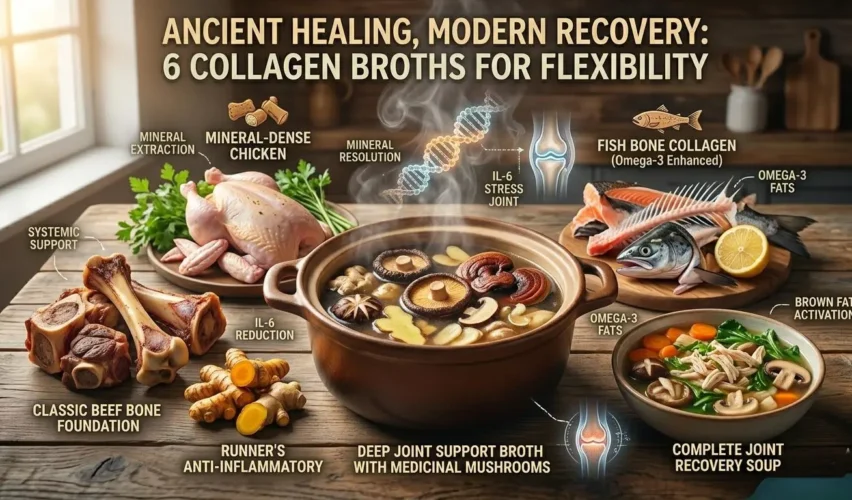
The six recipes provided Classic Beef Bone, Runner’s Anti-Inflammatory, Mineral-Dense Chicken, Deep Joint Support with Mushrooms, Fish Bone Omega-3 Enhanced, and Complete Joint Recovery Soup, are designed to fit different preferences and goals. They’re affordable ($1.50-5 per liter), simple to prepare, and produce measurable joint improvements.
Your joints aren’t permanent. Cartilage remodels. Connective tissue rebuilds. Bone density changes. With appropriate nutrition, these structures improve. With poor nutrition or no attention, they degrade.
Start this week with one batch of Classic Beef Bone Broth or Runner’s Anti-Inflammatory Broth. Simmer for 24 hours. Consume 250ml daily for a week. Notice how your joints feel, how recovery improves, and how training feels different.
Most runners experience measurable improvement within 4-8 weeks. By month 3, joint pain reduction becomes dramatic. By month 6, your joints are genuinely more durable and resilient.
This is where ancestral wisdom meets modern science. Humans have consumed bone broth for thousands of years because it works. Modern nutrition science validates what traditional cultures knew instinctively: collagen broth builds stronger, more resilient joints.
That’s not just recovery nutrition. That’s training durability. That’s the difference between training that breaks you down and training that builds you up.