Your shoulders took a beating in today’s workout. The pushups, the presses, the lateral raises all left your rotator cuff and deltoids fired up and fatigued.
Now comes the part most people get wrong: what you eat in the next few hours matters more than the work you just did.
Nutrition for shoulder workout recovery is not about chugging protein shakes or eating the first thing you see. It is about strategically fueling your muscles with the exact nutrients they need to repair, rebuild, and come back stronger. The right post-workout meal can cut recovery time in half, reduce soreness, and protect your joints from injury.
This guide covers five evidence-backed nutrition strategies for shoulder recovery, plus detailed recipes like omega egg shoulder boost bowls that turn recovery into something you actually want to eat.
Why Shoulder Recovery Demands Special Attention
Shoulder joints are different from other joints in your body. They are mobile, complex, and under constant stress during upper body training.
When you press, row, or push, you are not just working the muscle fibers. You are also stressing tendons, ligaments, and connective tissue that hold everything together. That is why shoulders are more prone to injury than, say, your quads.
Recovery is not optional. It is structural maintenance.
Proper post-workout nutrition addresses three recovery needs at once:
Muscle tissue repair. Protein synthesis happens fastest in the 30 to 60 minutes after training. Your muscles are primed to absorb amino acids and rebuild stronger.
Inflammation management. Intense shoulder work creates localized inflammation. While some inflammation is normal and necessary, excessive inflammation slows healing. That is where anti-inflammatory nutrients come in.
Joint and connective tissue support. Shoulders need collagen, vitamin C, and omega-3 fatty acids to keep tendons and ligaments resilient.
Missing any one of these, and your recovery stalls.
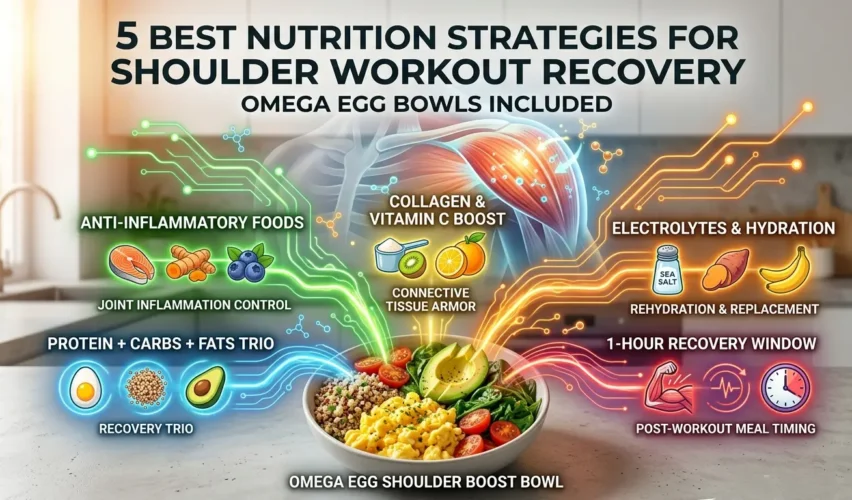
The 1-Hour Window: Why Timing Matters
You have probably heard the phrase “anabolic window.” The science is real, though not quite the way most people think about it.
After shoulder training, your muscles are in a heightened state of protein synthesis for about 24 hours. But the first 60 minutes is when your muscles are most sensitive to nutrients.
A study in the Journal of the International Society of Sports Nutrition found that consuming protein and carbs within one hour of training significantly increased muscle protein synthesis compared to waiting several hours.
For shoulder recovery specifically, this matters because shoulders depend heavily on small stabilizer muscles and connective tissue. These structures respond well to immediate nutrient timing.
The practical takeaway: Eat a meaningful meal or recovery bowl within 60 minutes of finishing your shoulder workout.
Strategy 1: Protein + Carbs + Healthy Fats (The Recovery Trio)
Every effective post-workout meal contains these three components. Here is why each matters.
Protein provides the amino acids your muscles need to rebuild. After shoulder work, aim for 25 to 40 grams of protein depending on your body weight and workout intensity.
Carbs replenish glycogen stores and trigger an insulin response that shuttles nutrients into muscle cells. Complex carbs like quinoa, sweet potato, and oats are ideal.
Healthy fats reduce inflammation, support hormone production, and improve nutrient absorption. Omega-3 sources are especially valuable for shoulder health.
When all three are present, recovery accelerates. When one is missing, the whole process slows down.
This is the foundation of the omega egg shoulder boost bowls you will see below.
Strategy 2: Anti-Inflammatory Foods Protect Joint Health
Shoulders are highly susceptible to overuse inflammation. Most people train them hard, then eat processed food, which amplifies inflammation.
The solution is deliberately choosing anti-inflammatory post-workout foods.
Top anti-inflammatory choices for shoulder recovery:
- Fatty fish (salmon, mackerel, sardines) for omega-3 EPA and DHA
- Eggs (especially the yolks) for choline and phospholipids
- Leafy greens like spinach and kale for polyphenols
- Berries for anthocyanins
- Ginger and turmeric for curcumin
- Extra virgin olive oil for oleocanthal
Build your post-workout meal around these foods, and your shoulder joints get active support during the recovery window.
Strategy 3: Collagen and Vitamin C for Connective Tissue
Muscles are not your only concern. Tendons and ligaments also need targeted support after intense shoulder training.
Collagen is the primary structural protein in connective tissue. It makes up roughly 75 percent of the dry weight of tendons. When you stress those tissues during training, collagen synthesis increases during recovery.
Consuming vitamin C alongside amino acids (especially glycine, proline, and hydroxyproline) supports collagen formation. Vitamin C is a critical cofactor in the enzyme that cross-links collagen molecules and makes them stable.
This is why bone broth or collagen peptides paired with citrus makes sense for shoulder recovery. Your body is literally using these nutrients to rebuild the structures that hold your shoulder together.
Best sources:
- Grass-fed bone broth (10 to 20 grams collagen per cup)
- Collagen peptides (easy to blend into smoothies or porridge)
- Citrus fruits, berries, and leafy greens (vitamin C)
- Kiwi (both collagen-supporting vitamin C and bromelain, which aids digestion)
Strategy 4: Electrolytes and Hydration
You sweat during shoulder work. That sweat is not just water, it is sodium, potassium, and magnesium. These minerals are essential for muscle contraction and recovery.
Most people drink water after training but neglect electrolyte replacement. That is a missed opportunity.
A simple strategy is to add a pinch of sea salt to your post-workout meal or drink. Even 300 to 500 milligrams of extra sodium supports rehydration and cellular nutrient uptake.
Potassium-rich foods like sweet potato, avocado, and banana also belong in post-workout nutrition.
Magnesium supports muscle relaxation and reduces cramping. It is another mineral depleted through sweat that deserves replacing.
The omega egg shoulder boost bowls below include salt, potassium, and magnesium sources naturally.
5 Omega Egg Shoulder Boost Bowls and Recovery Meals
Bowl 1: Classic Omega Egg Shoulder Boost
This is the foundation recipe. It hits every nutrition marker for shoulder recovery.
Ingredients:
- 3 large omega-3 eggs, scrambled or fried
- 1/2 cup cooked quinoa
- 1/4 avocado, sliced
- Handful of baby spinach, wilted
- 1/4 cup cherry tomatoes, halved
- 1 teaspoon extra virgin olive oil
- Sea salt and black pepper
- Fresh lemon juice
Instructions:
- Cook the quinoa while your eggs cook.
- Scramble or fry the eggs in a small amount of olive oil.
- Toss warm quinoa with wilted spinach.
- Arrange eggs, quinoa, avocado, and tomatoes in a bowl.
- Drizzle with olive oil and lemon juice.
- Season with sea salt and pepper.
Why it works for shoulder recovery: Three whole eggs provide 18 grams of protein plus choline for joint health. Quinoa supplies carbs and magnesium. Avocado adds anti-inflammatory fats and potassium. Spinach delivers vitamin C for collagen synthesis.
Prep time: 12 minutes
Macro breakdown: 35g protein, 45g carbs, 18g fat
Bowl 2: Smoked Salmon Anti-Inflammatory Recovery
Salmon is one of the most shoulder-friendly foods you can eat after training. EPA and DHA from salmon actively reduce joint inflammation.
Ingredients:
- 2 large eggs, soft-boiled
- 100g smoked salmon
- 1/2 cup cooked quinoa
- Handful of arugula
- 1/4 cucumber, sliced
- 1/4 red onion, thinly sliced
- 1 tablespoon raw almonds, crushed
- 1 teaspoon capers
- 1 tablespoon extra virgin olive oil
- Lemon wedge
Instructions:
- Soft-boil eggs for 6 to 7 minutes, then peel and halve.
- Arrange quinoa, arugula, cucumber, and red onion in a bowl.
- Top with salmon, eggs, almonds, and capers.
- Dress with olive oil and lemon juice.
Why it works: Smoked salmon delivers 25 grams of omega-3 fatty acids per 100g serving. This directly combats inflammation in shoulder joints. Eggs add protein and choline. Arugula contains sulforaphane, another anti-inflammatory compound.
Prep time: 10 minutes
Macro breakdown: 38g protein, 42g carbs, 15g fat
Bowl 3: Sweet Potato and Egg Post-Pushup Power Bowl
After heavy pushup circuits, your body is depleted of glycogen. Sweet potato replenishes this faster than white rice, plus it adds beta-carotene for tissue repair.
Ingredients:
- 2 large eggs, scrambled
- 1/2 medium sweet potato, roasted and cubed
- 1/4 cup cooked farro
- Large handful of spinach
- 1/4 cup roasted broccoli
- 1/4 bell pepper (any color), diced
- 1 tablespoon pumpkin seeds
- 1/2 teaspoon turmeric powder
- 1 tablespoon ghee or coconut oil
Instructions:
- Roast the sweet potato at 200°C for 20 minutes while you prepare other ingredients.
- Scramble eggs in ghee with turmeric.
- Toss warm farro with spinach to wilt slightly.
- Combine all components in a bowl.
- Top with pumpkin seeds.
Why it works: Sweet potato is a fast-digesting carb ideal for the post-workout window. Turmeric is proven to reduce exercise-induced muscle damage. Pumpkin seeds provide zinc, which supports immune function during heavy training phases.
Prep time: 25 minutes (including roasting)
Macro breakdown: 32g protein, 52g carbs, 14g fat
Bowl 4: Collagen-Boosted Breakfast Bowl for Joint Armor
This bowl is specifically designed for shoulder tendon and ligament health. The combination of collagen peptides, vitamin C, and amino acids directly supports connective tissue repair.
Ingredients:
- 2 large eggs, poached
- 1/2 cup cooked oats
- 1 tablespoon collagen peptides, stirred into the oats
- 1/2 cup fresh berries (blueberries and raspberries)
- 1 kiwifruit, sliced
- 1 tablespoon raw almond butter
- 1/4 teaspoon cinnamon
- 1 teaspoon raw honey
- Splash of whole milk or almond milk
Instructions:
- Cook oats in milk or water.
- Stir collagen peptides into warm oats.
- Poach eggs while oats cook.
- Layer oats in a bowl, top with poached eggs, berries, and kiwi.
- Drizzle almond butter and honey over the top.
- Sprinkle cinnamon.
Why it works: Collagen peptides provide the exact amino acids (glycine and proline) needed for connective tissue repair. Berries and kiwi deliver vitamin C, which is the critical cofactor for collagen cross-linking. This combination is unmatched for shoulder tendon health.
Prep time: 15 minutes
Macro breakdown: 28g protein, 48g carbs, 10g fat
Bowl 5: Quick Tuna and White Rice Recovery (Post-Light Sessions)
Not every shoulder workout demands an elaborate bowl. After lighter training days, something simpler works. This one is perfect for days when you did accessory work only.
Ingredients:
- 1 can (142g) wild-caught tuna in water, drained
- 1 cup cooked white rice (or jasmine rice)
- 2 tablespoons edamame
- 1/4 avocado
- Handful of nori seaweed sheets, cut into strips
- 1 tablespoon sesame oil
- 1 teaspoon tamari or low-sodium soy sauce
- Wasabi to taste
- Sesame seeds
Instructions:
- Cook rice if not already prepared.
- Flake tuna and mix with tamari and a small amount of sesame oil.
- Layer rice in a bowl, top with tuna, edamame, avocado, and nori.
- Drizzle remaining sesame oil.
- Top with sesame seeds and wasabi on the side.
Why it works: Tuna is leaner than salmon but still provides selenium and B vitamins that support recovery. White rice is ideal for quick glycogen replenishment on lighter days. Nori adds iodine, which supports thyroid function during recovery.
Prep time: 8 minutes
Macro breakdown: 32g protein, 44g carbs, 8g fat
Pre-Workout Nutrition Sets the Stage
Post-workout nutrition is important, but do not overlook what you eat before training.
If you start a shoulder workout depleted and dehydrated, recovery is compromised from the start. A small meal 60 to 90 minutes before training primes your body to train hard and recover effectively.
For early morning shoulder sessions, check out these fasted workout coffee recipes that provide a gentle fuel source without the heaviness of a full meal.
The combination of pre-workout fueling and strategic post-workout nutrition creates a recovery system that actually works.
Pro Tips of nutrition for shoulder workout recovery
Eat warm foods. Warm meals digest faster and trigger a stronger thermic response, which supports nutrient absorption. The bowls above are best eaten while still warm.
Prioritize whole foods over supplements. Supplements have a place, but whole foods contain dozens of micronutrients and phytocompounds that work synergistically. A real egg beats an amino acid tablet every time.
Do not fear carbs. Many people underfuel after training to “stay lean.” This backfires. Carbs trigger insulin, which shuttles amino acids into muscles. Skip the carbs, and protein synthesis stalls.
Rotate your protein sources. Eggs, fish, chicken, and plant-based proteins all offer different micronutrient profiles. Rotating them ensures you cover all your nutritional bases.
Sleep is part of nutrition. Recovery happens during sleep, not just after eating. A 3am meal means nothing if you are getting four hours of sleep. Prioritize sleep as part of your recovery strategy.
Stay hydrated throughout the day. Do not just drink water after training. Consistent hydration all day supports every physiological process involved in recovery.
Common Mistakes in Shoulder Recovery Nutrition
Skipping the meal entirely. Many people train, then do not eat for hours. This misses the critical recovery window when muscles are primed for nutrient uptake.
Eating only protein. Protein alone does not trigger insulin or replenish glycogen. Carbs are essential for effective post-workout recovery.
Choosing processed recovery foods. Most commercial post-workout shakes and bars are loaded with added sugars and lack the micronutrient density of whole foods.
Not including anti-inflammatory foods. Standard post-workout meals often neglect the specific anti-inflammatory nutrients shoulders need. This leaves your joint health unprotected.
Training shoulders too frequently without proper recovery nutrition. If you train shoulders four times per week without dialing in recovery nutrition, overuse injury is almost guaranteed.
Putting It All Together: A Sample Week
Here is how to build a real recovery nutrition plan around your shoulder training schedule.
Monday (Heavy Pressing Day): Eat the classic omega egg shoulder boost bowl or the smoked salmon bowl.
Wednesday (Accessory Work): Use the sweet potato and egg post-pushup bowl.
Friday (Moderate Intensity): Go with the collagen-boosted breakfast bowl to maximize connective tissue repair.
Saturday (Light Session or Active Recovery): The quick tuna and white rice recovery works well.
On non-training days, just eat balanced meals with protein, vegetables, and whole grains. Recovery nutrition is not complicated when you understand the principles.
The Science Behind Shoulder-Specific Nutrition
Most post-workout nutrition advice is generic. But shoulders have unique demands that warrant specialized feeding.
According to research from the American Journal of Sports Medicine, the shoulder complex depends heavily on dynamic stability from small rotator cuff muscles and stabilizer tendons. These structures are more prone to overuse injury than larger muscle groups.
This is why anti-inflammatory omega-3s and collagen-supporting nutrients matter so much for shoulder athletes. Your shoulders are not just muscles. They are a complex system that requires targeted nutritional support.
Conclusion
Nutrition for shoulder workout recovery is not a luxury. It is the difference between building resilient, healthy shoulders and spending the next six months dealing with inflammation and reduced mobility.
These five omega egg shoulder boost bowls and recovery strategies give you a practical framework. Start with whichever bowl sounds most appealing, then rotate through the others based on your training intensity that day.
The key is consistency. One perfect meal after one workout does not transform your recovery. But three to four weeks of deliberate post-workout nutrition will make your shoulders noticeably more resilient, less sore, and stronger.
Your shoulders carried you through the workout. Feed them well, and they will come back better.