Your legs are burning. Your heart is still racing. Sweat is dripping everywhere. You just crushed a sprint workout, and now your muscles are screaming for relief.
This is the moment when most athletes reach for water, Gatorade, or nothing at all. But there is a faster way to recover, and it sits in jars on grocery store shelves: pickle juice.
Pickle juice recipes post sprint workout sound unconventional until you understand the science. Pickle juice is loaded with sodium, potassium, and acetic acid, all of which combat muscle cramps, restore electrolyte balance, and accelerate recovery after intense anaerobic work like sprints and agility drills. Studies show that consuming pickle juice can reduce cramping onset by up to 37 percent compared to water alone.
In this guide, you will discover six practical pickle juice sprint quenchers that actually taste good, work fast, and fit seamlessly into your post-HIIT routine.
Why Pickle Juice Works So Well After Sprinting
Sprint training is brutal on the body. It depletes glycogen, triggers acute muscle damage, and flushes electrolytes through sweat at a faster rate than moderate cardio.
This is where most recovery strategies fall short. Water rehydrates, but it does not restore the mineral balance that sprinting destroys.
Sprinting depletes three critical electrolytes:
Sodium is the primary electrolyte lost through sweat. Your body needs sodium to maintain proper fluid balance, nerve signal transmission, and muscle contraction. Without sodium replacement, cramping is nearly inevitable.
Potassium supports muscle function and helps counterbalance sodium. After sprinting, potassium levels drop, which can cause delayed-onset cramping even hours after training.
Magnesium is often overlooked, but it is essential for muscle relaxation. Sprinting depletes magnesium, which is why many athletes experience tight, cramped muscles post-workout.
Pickle juice delivers all three, plus the acetic acid in vinegar appears to trigger reflex inhibition of cramp-causing muscle contractions. The combination is potent.
A 2010 study published in the Medicine and Science in Sports and Exercise journal found that pickle juice reduced cramping severity significantly faster than water alone. Cramping relief came within 85 seconds of consumption, suggesting a neurological rather than just chemical mechanism.
In practical terms, this means pickle juice works when cramps strike, not hours later.
The Science Behind Pickle Juice Recipes Post-Sprint Workout
Understanding how pickle juice works helps explain why these recipes are so effective.
When you sprint, your muscles enter an anaerobic state where they produce lactate and hydrogen ions. This metabolic stress, combined with electrolyte depletion, triggers cramping. The cramp is your nervous system’s way of protecting muscles from further damage.
Pickle juice short-circuits this response in two ways:
First, sodium concentration signals your body that hydration status is improving. High sodium content tells your nervous system to stop triggering protective cramps. Your muscles relax because they sense emergency conditions are resolving.
Second, the acetic acid in vinegar may directly interfere with the neural signals that cause cramping. Some research suggests acetic acid activates TRPV1 receptors in the mouth and throat, which can inhibit the motor neurons firing the cramps.
The result is rapid relief and faster recovery overall.
This is why pickle juice works best immediately post-sprint, not hours later. The sooner you consume it, the more effectively it prevents or stops cramping.
Sodium: The Electrolyte Sprinters Need Most
Sprinters lose more sodium per minute of training than any other athlete type. The intensity and duration of sprints create a massive electrolyte deficit in a short window.
A typical 30-second sprint can deplete 500 to 1000 milligrams of sodium. If you are doing multiple sprints or agility drills in one session, that number doubles or triples.
Standard water has zero sodium. Most sports drinks have 100 to 200 milligrams per serving. A single ounce of pickle juice has 400 to 600 milligrams depending on the brand.
This is why pickle juice is so effective. It delivers sodium concentration that matches what was actually lost during sprinting. It is not overkill like some electrolyte supplements, and it is not underdosed like plain water.
For post-sprint recovery, aim for 10 to 16 ounces of pickle juice or pickle juice mixed drinks within 15 to 30 minutes of finishing your last sprint. This window is when your body is most responsive to electrolyte replacement.
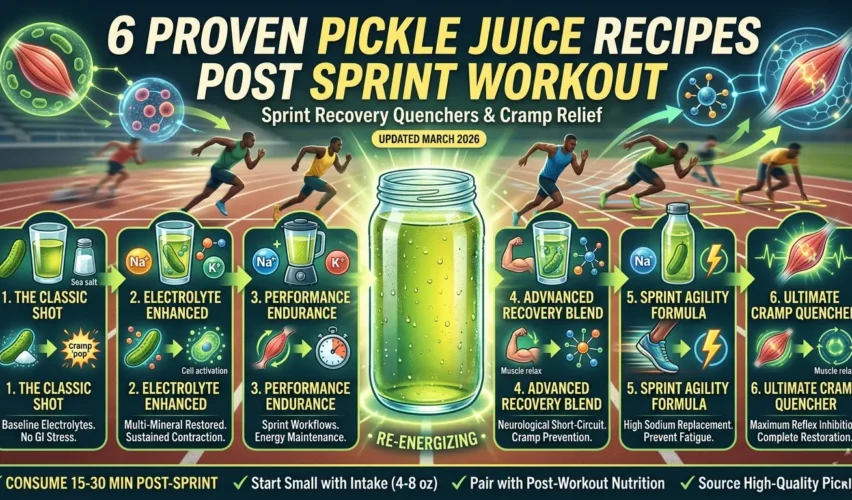
6 Pickle Juice Sprint Quencher Recipes
Recipe 1: Classic Pickle Juice Electrolyte Shot
This is the purest version. No mixing, no extras. Just straight pickle juice, which is exactly what some athletes prefer.
Ingredients:
- 4 ounces (120ml) fresh pickle juice, chilled
- Pinch of sea salt
- Optional: squeeze of fresh lemon
Instructions:
- Chill the pickle juice in the freezer for 10 minutes before your sprint session.
- Immediately after finishing your final sprint, drink it straight as a shot.
- Chase with 8 ounces of water if the taste is too intense.
Why it works: Straight pickle juice hits your system fastest. No dilution means maximum electrolyte concentration delivered immediately.
Best for: Athletes who want no-nonsense recovery and do not mind the sharp taste.
Sodium content: 600mg
Potassium content: 120mg
Consume timing: Immediately post-sprint
Recipe 2: Pickle Juice and Coconut Water Hybrid
Coconut water contains natural potassium and magnesium, which complements pickle juice perfectly. Together, they create a more complete electrolyte profile.
Ingredients:
- 3 ounces pickle juice
- 5 ounces pure coconut water (unsweetened)
- 1/2 teaspoon sea salt
- Squeeze of lime juice
- Ice
Instructions:
- Pour chilled pickle juice and coconut water into a glass.
- Add sea salt and lime juice.
- Stir well and add ice.
- Drink within 5 minutes of finishing sprints.
Why it works: Coconut water bridges the gap between pickle juice sodium and potassium. The combination tastes smoother than straight pickle juice while delivering superior electrolyte balance.
Best for: Athletes sensitive to vinegar taste but who need strong electrolyte recovery.
Sodium content: 650mg
Potassium content: 380mg
Magnesium content: 30mg
Recipe 3: Herbed Pickle Juice Sprint Quencher
Adding fresh herbs transforms pickle juice from medical-tasting to genuinely refreshing. Herbs also add phytonutrients that support inflammation reduction.
Ingredients:
- 4 ounces pickle juice
- 4 ounces water or low-sodium broth
- 4 to 5 fresh mint leaves, crushed
- 2 to 3 basil leaves, torn
- 1/4 teaspoon sea salt
- Squeeze of lemon or lime juice
- Ice
Instructions:
- Crush mint leaves gently in a glass to release oils.
- Add basil, then pour in pickle juice and water.
- Add salt and citrus juice.
- Stir and add ice.
- Strain out herb pieces if preferred, or drink them whole.
Why it works: Mint and basil are anti-inflammatory and aid digestion, which supports faster nutrient absorption. The herbs mask the harsh vinegar taste while adding antioxidants.
Best for: Athletes who find straight pickle juice too intense but want fast recovery.
Sodium content: 580mg
Potassium content: 140mg
Anti-inflammatory compounds: Yes (mint and basil polyphenols)
Recipe 4: Ginger-Turmeric Pickle Juice Recovery Drink
This version adds two of the most researched anti-inflammatory botanicals. Ginger and turmeric both reduce exercise-induced inflammation and muscle soreness.
Ingredients:
- 3 ounces pickle juice
- 5 ounces warm water or light broth
- 1/2 teaspoon fresh grated ginger (or 1/4 teaspoon ground)
- 1/4 teaspoon turmeric powder
- Pinch of black pepper (enhances turmeric absorption)
- 1/2 teaspoon raw honey
- Sea salt to taste
Instructions:
- Warm the water gently (do not boil).
- Add ginger, turmeric, and black pepper.
- Steep for 2 to 3 minutes.
- Pour in pickle juice and add honey.
- Stir well and drink warm within 10 minutes of finishing sprints.
Why it works: Ginger and turmeric directly reduce inflammation at the muscle level. Combined with pickle juice’s electrolyte profile, this becomes a comprehensive recovery drink that addresses both cramping and inflammation simultaneously.
Best for: Post-HIIT sessions where inflammation is a concern, or recovery for athletes over 35 who experience delayed muscle soreness.
Sodium content: 550mg
Potassium content: 100mg
Inflammation-fighting compounds: Gingerol and curcumin (clinically proven)
Recipe 5: Pickle Juice and Beet Juice Power Recovery
Beet juice is rich in nitrates, which improve blood flow and oxygen delivery to muscles. Paired with pickle juice, it accelerates nutrient delivery to fatigued muscles.
Ingredients:
- 2 ounces pickle juice
- 4 ounces fresh beet juice (or high-quality bottled, no added sugar)
- 2 ounces water
- 1/2 teaspoon sea salt
- Squeeze of fresh orange juice
- Ice
Instructions:
- Pour pickle juice, beet juice, and water into a glass.
- Add salt and orange juice.
- Stir thoroughly (the mixture will be dark).
- Add ice and drink immediately.
Why it works: Beet juice’s nitrates enhance blood flow, which helps shuttle electrolytes and oxygen to recovering muscles. The combination accelerates recovery noticeably compared to pickle juice alone.
Best for: High-intensity agility drills or multiple sprint sessions in one day.
Sodium content: 580mg
Potassium content: 280mg
Nitrate content: 500mg (supports blood flow and oxygen delivery)
Note: Beet juice is naturally sweet, so no added sugar is needed.
Recipe 6: Pickle Juice and Bone Broth Sprint Recovery
Bone broth provides collagen and amino acids that support muscle repair. Combined with pickle juice, it becomes a complete post-sprint meal in liquid form.
Ingredients:
- 3 ounces pickle juice
- 6 ounces warm bone broth (beef or chicken)
- 1/4 teaspoon sea salt
- 1/4 teaspoon black pepper
- 1/2 teaspoon fresh thyme or oregano
- Squeeze of lemon juice
- Optional: 1/4 teaspoon garlic powder
Instructions:
- Warm bone broth gently.
- Add pickle juice and remaining ingredients.
- Stir well and drink warm immediately after sprinting.
Why it works: Bone broth is savory and sustaining, making this feel like actual food instead of a supplement drink. The collagen supports muscle recovery, while pickle juice handles the immediate electrolyte crisis.
Best for: Extended training sessions (30 to 60 minutes of sprints) where calorie replacement is also needed.
Sodium content: 620mg
Potassium content: 160mg
Protein content: 10 to 12g
Collagen content: 8 to 10g
Timing Is Everything: When to Consume Pickle Juice
The effectiveness of pickle juice recovery depends heavily on timing.
Immediately post-sprint (0 to 15 minutes): This is the optimal window. Your nervous system is most responsive to electrolyte signals, and cramping prevention is most effective.
Within 30 minutes: Still effective, but cramping relief may take slightly longer (up to 2 to 3 minutes instead of under a minute).
Beyond 30 minutes: The benefits diminish significantly. Cramping patterns have already established, and electrolyte replacement is less urgent.
For maximum effectiveness, prepare your pickle juice recovery drink before sprinting so you can consume it immediately post-session.
Combining Pickle Juice Recovery with Nutrition Strategy
Pickle juice is a tool, not a complete recovery solution. Pair these sprint quenchers with smart post-workout nutrition to maximize results.
Within 60 minutes of finishing sprints, eat a meal with protein and carbs. This works synergistically with pickle juice to rebuild muscle and replenish energy.
For comprehensive post-sprint nutrition strategy, review these nutrition guidelines for shoulder workout recovery, which apply the same electrolyte and nutrient timing principles to different training modalities.
The combination of immediate pickle juice recovery plus thoughtful whole-food nutrition creates a system that truly accelerates adaptation.
How Much Pickle Juice Is Safe?
Pickle juice is safe for most people, but moderation matters.
A typical dose is 3 to 4 ounces per 200 pounds of body weight. For most athletes, this means 4 to 8 ounces per sprint session.
Do not exceed 16 ounces in a single sitting. High sodium intake all at once can cause digestive upset or temporary water retention.
Who should avoid or limit pickle juice:
- People with high blood pressure or sodium sensitivity (check with a doctor first)
- Those with ulcers or acid reflux (vinegar can aggravate these)
- Anyone taking medications that interact with high sodium intake
For everyone else, post-sprint pickle juice is safe and effective.
Pro Tips for Sprint Recovery Success
Chill it beforehand. Cold pickle juice tastes better and feels more refreshing post-sprint when your body temperature is elevated.
Start small if new to it. If pickle juice is unfamiliar, try 2 ounces first to assess tolerance. Many athletes feel stomach discomfort the first time because they are not used to the acidity.
Use high-quality pickle juice. Some brands add sugars, preservatives, or artificial flavors. Look for juice with minimal ingredients: cucumbers, vinegar, salt, and spices. That is it.
Do not rely on pickle juice alone. Electrolyte replacement is important, but full recovery requires protein, carbs, sleep, and consistent training. Pickle juice is one piece of a larger puzzle.
Experiment before race day. If you are planning to use pickle juice during a competition, test it during training first. You need to know how your stomach responds.
Pair with water intake. Do not just drink pickle juice and nothing else. Alternate with plain water or coconut water to maintain steady hydration without electrolyte overload.
Common Mistakes Athletes Make with Pickle Juice Recovery
Waiting too long after sprinting. The cramp-fighting effect diminishes rapidly. Consume within 15 minutes, not an hour later.
Using pickle juice as a replacement for meals. Electrolytes are important, but they do not provide the amino acids and carbs needed for actual muscle repair. Eat real food.
Assuming more is better. Chugging a liter of pickle juice does not accelerate recovery. Standard doses (4 to 8 ounces) are optimal. Excess becomes counterproductive.
Ignoring sodium sensitivity. Some people genuinely should avoid high-sodium drinks. Do not force pickle juice recovery if you have been advised to limit sodium intake.
Not hydrating with water. Pickle juice is concentrated. You still need water or other fluids to complete the rehydration picture.
The Research Behind Pickle Juice and Sprint Performance
A 2010 study in Medicine and Science in Sports and Exercise specifically tested pickle juice on cramping after intense exercise. Researchers found that cramping relief occurred within 85 seconds of consuming pickle juice, significantly faster than water alone.
The study was small (14 participants) but showed consistent results. The mechanism appears to involve both electrolyte replacement and a neurological reflex triggered by the acetic acid in vinegar.
Follow-up research has been limited, which is why pickle juice is sometimes overlooked by mainstream sports nutrition. But the evidence available strongly supports its use for immediate post-sprint recovery, specifically for cramp prevention and relief.
Sprint Recovery Beyond Pickle Juice
Pickle juice is exceptional for immediate post-sprint recovery, but your overall sprint development depends on more than one drink.
Sleep: This is where actual muscle repair happens. Prioritize 7 to 9 hours nightly.
Consistent nutrition: Whole foods, adequate protein, and proper carb timing matter more than any supplement.
Progressive training: Sprinting demands proper programming. Do not just run as fast as you can randomly.
Mobility work: Tight muscles are prone to cramping. Spend 10 to 15 minutes on stretching and mobility after each sprint session.
Recovery days: Do not sprint hard every day. Your nervous system needs recovery just like your muscles do.
Pickle juice quenchers handle the acute electrolyte recovery beautifully. Everything else requires consistent daily attention.
Conclusion
Pickle juice recipes post sprint workout are not a gimmick. They are a clinically supported recovery tool that works fast, tastes better with the right recipe, and fits naturally into your training schedule.
These six pickle juice sprint quenchers give you options based on taste preferences, available ingredients, and your specific recovery needs. Start with whichever version appeals to you most, then experiment with the others.
The key is timing: consume your chosen recipe within 15 minutes of finishing sprints, then eat a solid post-workout meal within an hour.
Over time, consistent pickle juice recovery combined with smart nutrition and adequate sleep will transform how you feel after intense sprint training. Your legs will cramp less, recover faster, and perform better in your next session.
Your recovery starts with a jar. Make it count.